
Rejecting an inappropriate referral is justified whenever accepting it would compromise patient safety, exceed your facility’s clinical scope, violate payor eligibility rules, or impose an operational burden that undermines care for patients already in your system. That is not gatekeeping. It is responsible stewardship of your team’s capacity and your patients’ wellbeing.
The primary, defensible reasons to decline a referral fall into four categories:
- Clinical mismatch: The patient’s diagnosis or care needs fall outside your specialty or service line.
- Insufficient information: Critical clinical data, medication lists, or diagnostic results are missing, making safe admission impossible to assess.
- Eligibility or payor mismatch: The patient’s insurance is not accepted, or coverage does not extend to the required level of care.
- Duplicative or capacity-based referral: The patient is already receiving equivalent care, or no appropriate bed or service is currently available.
Every rejection should be documented with a clinical rationale, a timestamp, and the staff member’s name, then communicated to the referring provider within 24 hours with a suggested alternative pathway.
Table of Contents
- What counts as an inappropriate referral in your facility
- Why rejecting inappropriate referrals matters for safety, operations, and reputation
- Legal and ethical constraints you must check before declining a referral
- Step-by-step workflow to triage, document, and communicate a rejected referral
- Quick accept / redirect / decline checklist for triage
- How to communicate rejections to referrers and patients
- How to measure and reduce inappropriate referrals with QI and technology
- Four common scenarios with ready-to-use response language
- Key Takeaways
- Selective rejection is strategic, not punitive
- Smartadmissions helps your team catch unsuitable referrals before they reach the floor
- Authoritative U.S.-focused sources and further reading
What counts as an inappropriate referral in your facility
An inappropriate referral is one whose clinical, administrative, or eligibility profile makes it unsuitable for the receiving service at the time of submission. The definition is operational, not judgmental: the referral may be entirely appropriate for a different provider or a different moment in the patient’s care journey.
Research published in BMC Health Services Research highlights that increasing specialization and standardized pathways are creating more mismatches, particularly for patients with multiple chronic conditions whose presentations do not fit neatly into a single specialty’s criteria.
The five most common types your team will encounter:
- Wrong specialty or service line: A referral sent to radiology for a condition that requires gynecologic evaluation, or to a skilled nursing facility for a patient who needs acute psychiatric stabilization. One ultrasound center audit found that 272 of 5,234 referral requests (5.2%) were rejected, with wrong-specialty submissions among the top causes.
- Unclear or absent clinical question: The referral letter does not specify what the receiving provider is expected to assess, diagnose, or manage.
- Incomplete documentation: Missing lab results, imaging reports, medication reconciliation, or prior authorization paperwork that the receiving clinician needs to make a safe admission decision.
- Eligibility or insurance mismatch: The patient’s payor is not contracted with your facility, the level of care requested is not covered, or prior authorization has not been obtained.
- Capacity-based exclusion: No appropriate bed, staffing configuration, or specialized service is currently available to deliver safe care.
Recognizing which category a referral falls into is the first step toward a defensible, documented response.
Why rejecting inappropriate referrals matters for safety, operations, and reputation

Accepting a referral your facility cannot safely serve does not help the patient. It delays their access to the right care, exposes them to interventions outside your team’s competency, and adds documentation and compliance work that strains your staff.
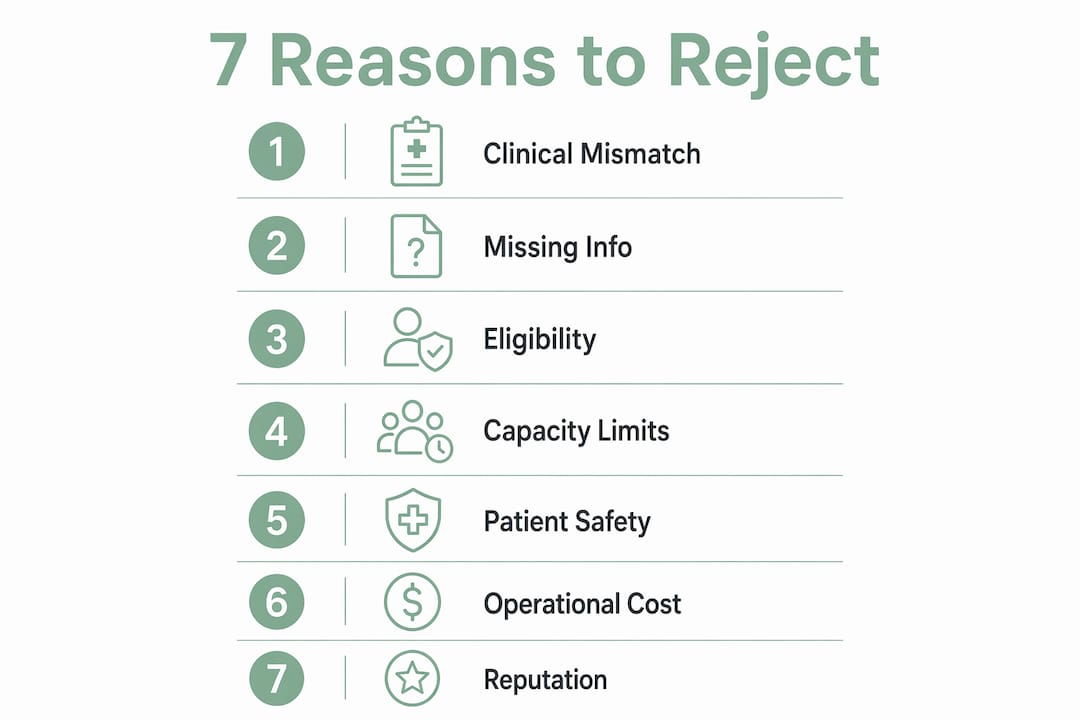
Patient safety is the primary concern. A skilled nursing facility that admits a patient requiring acute wound care beyond its clinical capacity risks adverse outcomes: wound deterioration, infection, and potential readmission. The RCGP’s referral management guidance explicitly warns that referral management approaches focused solely on volume reduction, without clinical judgment, can risk patient safety and undermine professional accountability.
Operational costs are often invisible until they accumulate. The true cost of an unsuitable referral includes medication management oversight, additional compliance documentation, staffing reallocation, and the administrative burden of managing a patient whose needs exceed your service’s design. These hidden operational burdens can make certain admissions effectively unprofitable before the patient arrives.
Staff morale and team focus are at stake. When your admissions team repeatedly processes referrals that should never have reached them, the cumulative effect is burnout and reduced attention to the patients already in your care. Selective acceptance protects staff efficiency and preserves the team’s capacity to deliver high-quality care where it matters.
The reputational argument is equally concrete. Facilities that accept every referral regardless of fit develop a reputation among referrers for poor outcomes on complex cases, and implementing effective SEO for medical professionals strategies can help preserve professional communication and strengthen your practice’s reputation. Selective acceptance, communicated professionally, signals clinical credibility.
Pro Tip: Frame rejections internally as “capacity protection decisions,” not denials. This language helps your admissions team understand that saying no to the wrong referral is part of delivering excellent care to the right patients.
Legal and ethical constraints you must check before declining a referral
Declining a referral in the United States carries regulatory and ethical obligations that vary by setting, payor, and patient presentation. Your team needs a clear checklist before any rejection is finalized.
Primary legal touchpoints:
- EMTALA (Emergency Medical Treatment and Labor Act): If your facility has an emergency department or is a Medicare-participating hospital receiving a transfer request, EMTALA requires you to provide a medical screening examination and stabilizing treatment before any transfer or refusal. Declining an ED transfer without meeting EMTALA obligations exposes your facility to significant civil monetary penalties. Review the CMS EMTALA guidance before establishing any blanket rejection policy for transfer referrals.
- HIPAA: When communicating a rejection to a referring provider, share only the minimum necessary clinical information. Avoid including protected health information in unsecured email or fax without appropriate safeguards.
- CMS coverage and eligibility rules: Medicare and Medicaid coverage determinations affect which patients your facility can legally admit under its certification. A referral that falls outside your CMS-certified level of care is not just operationally unsuitable — accepting it may constitute a billing compliance violation.
- State licensure and scope-of-practice rules: Your facility’s state license defines the services you are authorized to deliver. Admitting a patient whose needs exceed that scope is a licensure risk, not just a clinical one.
Ethical obligations:
- Non-discrimination: Rejections must be based on clinical, eligibility, or capacity criteria — never on race, ethnicity, disability, or other protected characteristics. Document the specific clinical or administrative rationale for every rejection.
- Patient abandonment: If your facility has an existing care relationship with the patient, declining a referral for continued or escalated care requires a formal transition plan and adequate notice.
- Duty to provide a safe alternative: Ethically and practically, every rejection should include a suggested alternative pathway. Leaving a patient or referrer without a next step is not a defensible position.
When to seek legal review: Any rejection involving an EMTALA-covered transfer, a patient with a protected characteristic, or a situation where the clinical rationale is ambiguous should be reviewed by your facility’s legal counsel or compliance officer before the decision is communicated. Document that review in the referral file.
This article provides general operational and educational information, not legal or compliance advice. Confirm current regulatory requirements with CMS, your state health department, or qualified legal counsel for your specific situation.
Step-by-step workflow to triage, document, and communicate a rejected referral
A reproducible process protects your team, your patients, and your facility’s compliance record. The following workflow applies to skilled nursing facilities, rehabilitation centers, and post-acute care providers.
Phase 1: Intake triage (within 2 hours of receipt)
- Confirm the referral is complete: clinical summary, diagnosis, medication list, insurance information, and referring provider contact.
- Run a preliminary eligibility check against your accepted payors and CMS certification level.
- Screen for clinical scope: does the patient’s primary diagnosis and care needs fall within your licensed service lines?
- Flag any EMTALA-relevant transfer requests for immediate medical director review.
Phase 2: Decision point (within 4 hours)
The admissions coordinator, in consultation with the clinical lead or medical director, selects one of four outcomes:
- Accept: Patient meets all clinical, eligibility, and capacity criteria.
- Request clarification: Missing information prevents a decision; return to referrer with a specific list of what is needed.
- Redirect: Patient is appropriate for care but not at this facility; identify and document the recommended alternative.
- Decline: Patient does not meet clinical, eligibility, or capacity criteria; document the specific rationale.
Phase 3: Documentation (before notification)
Your referral documentation record must capture:
- Clinical rationale for the decision (referenced to your facility’s admission criteria or clinical pathway)
- Payor/eligibility finding, if applicable
- Timestamp and staff name
- Medical director or clinical lead sign-off for declines
- Storage location in your EMR or referral management system
Phase 4: Communication (within 24 hours of decision)
Notify the referring provider first, then the patient or their representative. Include the reason for the decision, the clinical basis, and a specific alternative pathway or next step.

Pro Tip: Before logging a referral as a rejection, ask whether it is actually a request for clarification. Research confirms that many “rejections” reflect missing intake data rather than a genuine clinical mismatch. Treating them as clarification requests reduces unnecessary declines and preserves referral relationships.
Pro Tip: Log every rejection — including redirects and clarification requests — in a dedicated QI tracker. Reviewing that log monthly reveals patterns: which referrers consistently send incomplete information, which diagnoses are routinely misrouted, and where your intake form needs redesign.
Quick accept / redirect / decline checklist for triage
Use this checklist at the point of intake. Each question requires a clear yes or no before the decision is recorded.
Scope and eligibility:
- [ ] Is the patient’s primary diagnosis within our licensed service lines?
- [ ] Does the patient’s required level of care match our CMS certification?
- [ ] Is the patient’s insurance accepted, and is prior authorization in place or obtainable?
- [ ] Is the clinical information sufficient to make a safe admission decision?
Capacity and safety:
- [ ] Is an appropriate bed or service currently available?
- [ ] Does our staffing configuration support this patient’s care needs safely?
- [ ] Are there any EMTALA obligations triggered by this referral?
Decision and next step:
| Outcome | Trigger | Immediate next step |
|---|---|---|
| Accept | All boxes checked | Confirm bed, notify referrer, begin admission |
| Request clarification | Missing clinical or admin data | Contact referrer with specific list within 2 hours |
| Redirect | Clinical mismatch, wrong level of care | Identify alternative provider, document recommendation |
| Decline | Eligibility, capacity, or scope failure | Document rationale, notify referrer within 24 hours |
Escalation: Involve your medical director when the clinical rationale is ambiguous. Involve legal counsel when EMTALA, discrimination risk, or patient abandonment concerns are present. Document both consultations in the referral record.
How to communicate rejections to referrers and patients
The way your team communicates a rejection determines whether the referral relationship survives it. A clear, professional, and timely message that offers a concrete next step preserves goodwill and reduces disputes. Selective rejection paired with polite feedback and alternative referrals is consistently associated with stronger professional credibility over time.
Every notification should include:
- The decision (accept, redirect, or decline) stated plainly in the first sentence
- The specific clinical or administrative reason, referenced to your admission criteria
- A concrete alternative: another provider, a different level of care, or the information needed to reconsider
- A contact name and direct phone number for questions
- The date and time of the decision
Template A: Request for clarification (send within 2 hours)
Template B: Redirect to another specialty or level of care (send within 24 hours)
Template C: Decline with alternatives (send within 24 hours)
Pro Tip: Always end every communication with an offer to discuss. A referrer who can call and get a clear explanation is far less likely to escalate a dispute than one who receives a form letter with no follow-up path. This single habit, applied consistently, protects your referral network.
How to measure and reduce inappropriate referrals with QI and technology
Tracking rejections without acting on the data is a missed opportunity. The following metrics and interventions give your team a structured path from measurement to improvement.
Core metrics to track:
- Rejection rate: Total rejections divided by total referrals received, by referrer and by diagnosis category
- Time-to-notify: Hours from referral receipt to communication of the decision
- Clarification conversion rate: Percentage of clarification requests that convert to accepted admissions
- Downstream adverse events: Readmissions or adverse outcomes linked to referrals that were accepted despite borderline criteria
- Staff time per referral: Average hours spent on intake review, broken down by decision type
Tracking referral acceptance versus denial over time reveals which referrers, diagnoses, and payors generate the most friction and where your intake process needs reinforcement.
QI interventions with evidence:
| Intervention | Evidence strength | Expected impact |
|---|---|---|
| Shared referral criteria (published to referrers) | Strong | Reduces wrong-specialty and incomplete referrals |
| E-consults and bidirectional communication | Strong | Reduces unnecessary referrals; improves appropriateness |
| Intake form redesign (structured fields) | Moderate | Reduces missing-information rejections |
| Targeted referrer education sessions | Moderate | Reduces repeat errors from high-volume referrers |
| Automated eligibility verification at intake | Strong | Eliminates payor-mismatch admissions before review |
| Referral analytics dashboards | Moderate | Identifies systemic patterns for QI prioritization |
Research confirms that allowing consultants to contact referring providers directly and using e-consults or shared consultations reduces referral volume and improves appropriateness — without adding triage steps that delay care.
QI pilot implementation checklist:
- Identify stakeholders: admissions coordinator, clinical lead, medical director, IT lead
- Define baseline metrics using the six measures above
- Select one intervention (e.g., intake form redesign or referrer education)
- Set a 90-day timeline with monthly metric reviews
- Define success criteria: for example, a 20% reduction in missing-information rejections within 90 days
- Report findings to leadership and adjust the intervention based on results
Setting clear referral criteria and publishing them to your referral network is one of the highest-leverage steps your facility can take to reduce inappropriate submissions before they reach your intake team.
Four common scenarios with ready-to-use response language
These scenarios reflect the most frequent situations your admissions team will encounter. Adapt the language to your facility’s voice and documentation standards.
Scenario 1: Wrong specialty referral
A referring physician sends a patient with suspected ovarian pathology to your imaging center for a general ultrasound, when the clinical question requires a gynecologic evaluation.
Documentation required: Referral date, patient ID, clinical summary received, specific reason for redirect (clinical question requires gynecologic specialty evaluation), alternative recommended.
Sample message to referrer: “We have reviewed your referral and determined that the clinical question — suspected ovarian pathology — requires a gynecologic evaluation rather than a general ultrasound. We recommend referral to a gynecology specialist. Please contact us at [phone] if you would like to discuss.”
Scenario 2: Incomplete information for a high-risk case
A referral arrives for a patient with a complex wound and a history of MRSA, but no recent lab results, wound care notes, or medication list are included.
Documentation required: Referral date, patient ID, specific missing items listed, date clarification was requested, deadline given.
Sample message to referrer: “We cannot safely assess this referral without the following: current wound care notes, recent CBC and culture results, and a complete medication list. Please submit these by [date]. We will complete our review within 24 hours of receipt.”
Scenario 3: Insurance/eligibility mismatch
The patient’s primary insurance is a plan your facility does not accept, and no secondary coverage is listed.
Documentation required: Payor name, reason for ineligibility, date of eligibility check, alternative options provided.
Sample message to referrer: “After eligibility review, we are unable to admit this patient under [payor name], which is not contracted with our facility. We recommend contacting [type of alternative provider] or exploring secondary coverage options. Our admissions team is available at [phone] to assist.”
Scenario 4: Capacity-based decline
No appropriate bed or staffing configuration is currently available for a patient requiring two-person assist and bariatric equipment.
Documentation required: Date of capacity assessment, specific resource gap identified, escalation steps taken, alternative options offered.
Sample message to patient representative: “We are currently unable to accommodate [patient name]’s care needs because the specialized equipment and staffing required are not available at this time. We are actively working to identify an appropriate placement and will contact you by [date/time] with an update. Please call [name] at [phone] with any questions.”
Key Takeaways
Rejecting an inappropriate referral is a clinical and operational responsibility: done correctly, with documented rationale and a clear alternative, it protects patient safety, preserves your team’s capacity, and strengthens your facility’s credibility with referrers.
| Point | Details |
|---|---|
| Four core rejection reasons | Clinical mismatch, missing information, eligibility/payor failure, and capacity constraints are the defensible grounds for declining a referral. |
| Document every decision | Capture clinical rationale, timestamp, staff name, and medical director sign-off before communicating any rejection. |
| Notify within 24 hours | Referrers and patients should receive a decision, a reason, and a concrete alternative within 24 hours of the intake review. |
| Measure and improve | Track rejection rate, time-to-notify, and clarification conversion rate monthly to identify systemic intake problems. |
| Smartadmissions automates intake | Smartadmissions’s eligibility verification, EMR integration, and rejection analytics reduce manual review time and prevent unsuitable referrals from advancing. |
Selective rejection is strategic, not punitive
The conventional framing of referral rejection as a negative outcome gets it backwards. Every facility has a defined clinical scope, a finite staffing capacity, and a compliance obligation to the patients already in its care. Accepting a referral that falls outside those boundaries does not expand access — it dilutes the quality of care your team can deliver to everyone.
The evidence supports a more deliberate posture. Business and operational analysis consistently shows that the wrong referrals consume disproportionate resources and can derail core work, making selective rejection a strategic protection of operational momentum. In healthcare, that logic applies with even greater force: a mismatched admission does not just cost money, it costs clinical attention.
What I find most underappreciated in this conversation is the communication piece. Facilities that decline referrals without offering a clear alternative are the ones that damage relationships and invite disputes. Facilities that decline with a specific redirect, a direct contact, and a professional explanation consistently report stronger referral networks over time. The decision and the communication are inseparable. Getting one right without the other is not enough.
Selective acceptance, practiced transparently and documented rigorously, is one of the clearest signals a facility can send about the quality of care it delivers. It tells referrers: we know what we do well, and we will tell you honestly when a patient needs something different.
Smartadmissions helps your team catch unsuitable referrals before they reach the floor
The workflows described in this guide require consistent data at intake: payor information, clinical summaries, medication lists, and eligibility status. When that data arrives incomplete or in unstructured formats, your admissions team spends hours chasing it manually — and rejections that could have been prevented become inevitable.

Smartadmissions addresses that problem at the source. Its AI-powered intake assistant extracts clinical and payor data from referral documents automatically, runs real-time insurance eligibility verification against your contracted payors, and flags clinical mismatches before a referral advances to full review. The result is fewer avoidable rejections, faster decisions, and a documented audit trail for every intake outcome. Facilities using Smartadmissions report faster bed occupancy and reduced administrative burden on admissions staff.
The platform integrates with your existing EMR using FHIR and HL7 standards, so your team works within familiar systems rather than learning new ones. Rejection analytics and dashboards surface patterns by referrer, diagnosis, and payor — giving your QI team the data it needs to reduce inappropriate submissions at the source. For a practical overview of how referral management systems can be structured for your facility type, the Smartadmissions resource library is a strong starting point. Request a demo or start a free trial at smartadmissions.ai to see how the intake workflow maps to your current process.
Authoritative U.S.-focused sources and further reading
- BMC Health Services Research: Hospital triage of general practice referrals — Peer-reviewed analysis of how standardized pathways contribute to referral rejection rates, with implications for multimorbidity patients.
- BMJ Open Quality: GP request rejections at one ultrasound center — Focused audit with rejection rate data and root-cause categories; useful for benchmarking and intake form design.
- RCGP: Quality patient referrals — Right Service, Right Time — Authoritative clinical guidance on referral quality, with warnings about patient safety risks from volume-focused triage.
- CMS EMTALA guidance — The primary federal regulatory source for transfer and refusal obligations in Medicare-participating facilities.
- HHS HIPAA for Professionals — Authoritative guidance on minimum necessary standards and permissible disclosures when communicating referral decisions.
- PubMed: The nature of inappropriate referrals to wellness services — Peer-reviewed study examining referral appropriateness criteria and their application in practice.
- Rhythm of Business: Handling bad referrals — Practitioner guidance on reframing rejections as clarification requests and preserving referral relationships.
- InMyTeam: Why home care agencies should stop accepting every referral — Operational analysis of hidden costs in unsuitable admissions, including medication complexity and insurance gaps.