
TL;DR:
- Smartadmissions is a tailored platform that improves SNF and post-acute admissions through closed-loop referral tracking and EMR integration. It delivers measurable results such as faster bed occupancy, reduced administrative workload, and enhanced referral analytics. Its focus on automation and real-time data makes it the top choice for replacing ReferralMD in skilled nursing facilities.
For skilled nursing and post-acute facilities, Smartadmissions is the strongest alternative to ReferralMD, combining closed-loop referral tracking, real-time EMR integration, automated eligibility verification, and measurable bed-fill outcomes in a single platform built specifically for admissions teams. If you need a quick shortlist before diving into the details, here it is:
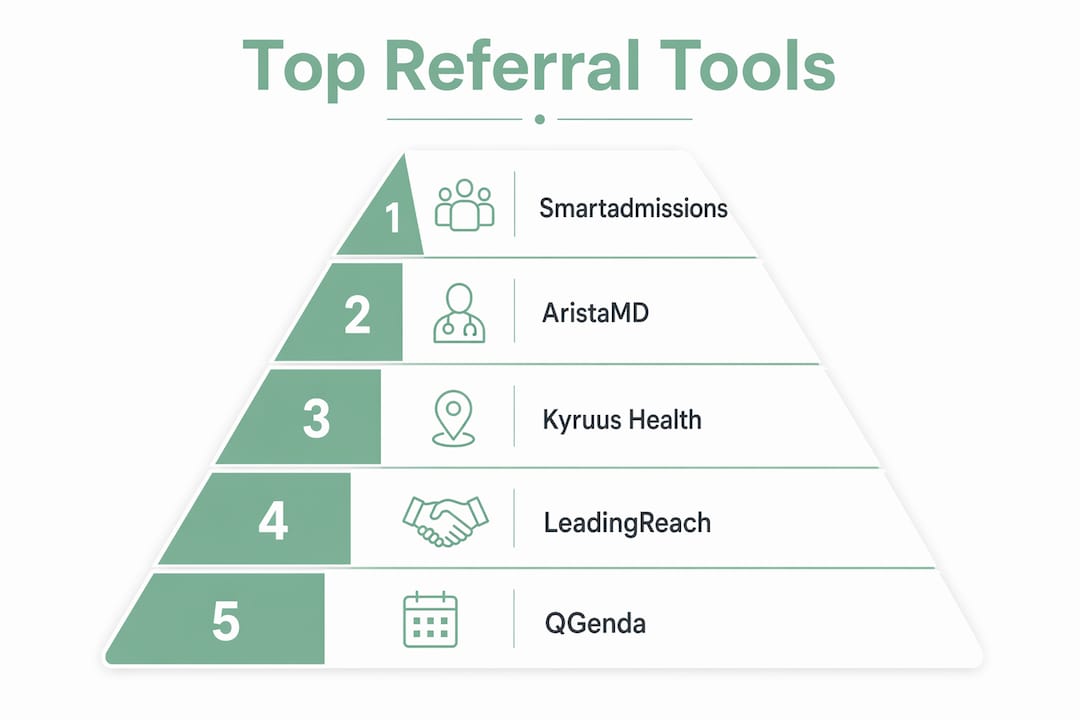
- Smartadmissions — best for SNF and post-acute admissions; AI-powered intake automation, closed-loop referrals, and EMR/FHIR integration with measurable bed-occupancy outcomes
- AristaMD — best for eConsult workflows between primary and specialty care; reduces unnecessary specialist visits
- Kyruus Health — best for large health systems managing provider search, directory accuracy, and referral routing at scale
- LeadingReach — best for community-based referral networks that need real-time tracking and fax replacement
- QGenda — best for facilities where provider scheduling and workforce management are the primary bottleneck
- Weave — best for smaller practices that need patient communication, scheduling, and basic referral coordination in one tool
TL;DR: The single most important factor when replacing ReferralMD is closed-loop referral capability combined with bidirectional EMR integration. Every vendor on this list handles referral routing; far fewer can prove that consult notes reliably return to the referring chart.
Table of Contents
- How do these getreferralmd.com alternatives compare side by side?
- What does each alternative actually offer your admissions team?
- How do you choose the right ReferralMD alternative for your facility?
- Why do closed-loop referrals and referral intelligence matter this much?
- Key Takeaways
- What facility admins actually decide on during demos
- Smartadmissions gives your admissions team a measurable edge
- Sources and further reading
How do these getreferralmd.com alternatives compare side by side?
The table below covers buyer-critical dimensions for SNF and post-acute admissions teams. Pricing shapes are based on publicly available information; exact figures require vendor confirmation during a demo.

| Dimension | Smartadmissions | AristaMD | Kyruus Health | LeadingReach | QGenda | Weave |
|---|---|---|---|---|---|---|
| Best for | SNF / post-acute admissions | eConsults, primary-to-specialty | Large health systems | Community referral networks | Provider scheduling / workforce | Small practices, patient comms |
| Key features | Automated intake, eligibility verification, closed-loop referrals, analytics | eConsult routing, specialist matching, consult note return | Provider directory, referral routing, access management | Real-time referral tracking, fax replacement, loop closure | Scheduling automation, on-call management, credentialing | Scheduling, two-way texting, basic referral coordination |
| EMR integrations | HL7/FHIR, major EMR connectors | HL7/FHIR, Epic, Cerner | HL7/FHIR, Epic, Cerner, Meditech | HL7v2, direct EMR connections | HL7/FHIR, Epic, Cerner | Limited EMR integration; primarily practice management |
| Closed-loop capability | Yes — automated consult note return and referral status tracking | Yes — eConsult note returned to referring chart | Partial — referral routing with status updates | Yes — real-time tracking and automated follow-up | Limited — scheduling-focused, not referral-loop-focused | Limited — communication-focused |
| Pricing model | Subscription per facility; contact for pricing | Subscription; contact for pricing | Enterprise contract; contact for pricing | Subscription; contact for pricing | Enterprise contract; contact for pricing | Subscription per seat; tiered plans |
| Onboarding / time to value | Designed for fast onboarding; dedicated support | Moderate; integration-dependent | Longer enterprise implementation | Moderate; network setup required | Longer enterprise implementation | Fast for small practices |
| Analytics & reporting | Referral volume, bed-fill rate, staff productivity, eligibility outcomes | eConsult volume, specialist utilization | Provider utilization, access metrics | Referral status, conversion rates | Scheduling efficiency, utilization | Basic scheduling and communication metrics |
| Customer support | Dedicated implementation and ongoing support | Implementation support included | Enterprise-level support | Implementation and account management | Enterprise support | Phone, chat, email support |
| HIPAA / security | HIPAA-compliant; BAA available | HIPAA-compliant; BAA available | HIPAA-compliant; BAA available | HIPAA-compliant; BAA available | HIPAA-compliant; BAA available | HIPAA-compliant; BAA available |
Key callout: Pricing transparency is a gap across almost every vendor on this list. None publish per-facility rates publicly, which means your demo conversation must include a direct pricing discussion before you invest time in a pilot. If a vendor deflects that question, treat it as a red flag.
What does each alternative actually offer your admissions team?
Smartadmissions
Smartadmissions is purpose-built for skilled nursing facilities, rehabilitation centers, and post-acute care providers. Where most referral platforms focus on routing, Smartadmissions focuses on the full admissions cycle: automated intake parsing, real-time insurance eligibility verification, clinical status assessment, and closed-loop referral tracking that confirms the consult note returned to the referring chart.

The platform integrates with existing EMR systems via HL7 and FHIR standards, which means your admissions coordinators work inside familiar workflows rather than toggling between systems. Facilities using referral automation and eligibility verification report measurable improvements in bed occupancy and reduced staff administrative workload. Analytics dashboards give admissions directors visibility into referral volume, conversion rates, and staff productivity from a single view.
Pros:
- Closed-loop referral tracking with automated follow-up
- Real-time eligibility verification reduces claim denials
- Built specifically for SNF and post-acute workflows, not adapted from a hospital platform
- Fast onboarding with dedicated implementation support
- Customizable automation rules for different payer types and clinical criteria
Cons:
- Not designed for large health system provider directory management
- Pricing requires a direct conversation with the sales team
Integration note: Connects via HL7v2 and FHIR APIs. Dedicated integration support is included in onboarding. Demo/trial: Available on request. Implementation timeline: Designed for rapid deployment; most facilities reach operational status within weeks, not months.
AristaMD
AristaMD specializes in eConsult workflows, connecting primary care providers with specialists through asynchronous consultations that reduce unnecessary in-person referrals. The platform’s core value is speed: a primary care provider submits a clinical question, a specialist responds with a consult note, and that note returns to the referring chart automatically.
For SNF and post-acute facilities, AristaMD is most relevant when your team manages complex patients who need specialist input before or during admission. It is not a full admissions management platform, so it works best alongside an intake system rather than as a standalone replacement for ReferralMD.
Pros:
- Strong closed-loop eConsult workflow with documented note return
- Reduces specialist visit volume and associated costs
- HIPAA-compliant with BAA; integrates with Epic and Cerner
Cons:
- Narrow use case; does not cover intake automation or eligibility verification
- Less suited to high-volume SNF admissions workflows
Integration note: HL7/FHIR compatible; Epic and Cerner connectors available. Demo: Available on request. Implementation timeline: Moderate; depends on EMR integration complexity.
Kyruus Health
Kyruus Health is an enterprise-grade provider access management platform. Its primary strength is maintaining accurate provider directories and routing referrals to the right specialist based on availability, location, and insurance. Large health systems use it to reduce referral leakage and improve patient access.
For SNF and post-acute facilities, Kyruus Health is most relevant if your facility is part of a larger health system that has already deployed it. As a standalone purchase for a single SNF, the enterprise scope and implementation timeline may outweigh the benefit.
Pros:
- Strong provider directory accuracy and referral routing at scale
- Deep integrations with Epic, Cerner, and Meditech
- Robust analytics on provider utilization and access patterns
Cons:
- Enterprise implementation timeline; not designed for rapid SNF deployment
- Pricing and contract structure suited to large health systems, not individual facilities
- Limited focus on post-acute-specific intake workflows
Integration note: HL7/FHIR, Epic, Cerner, Meditech. Demo: Available for enterprise prospects. Implementation timeline: Longer; typically several months for full deployment.
LeadingReach
LeadingReach focuses on replacing fax-based referral workflows with real-time digital tracking. Its core promise is that every referral sent through the network is tracked, acknowledged, and followed up automatically, which directly addresses the closed-loop problem that costs the industry an estimated $150 billion in unresolved referrals.
For SNF and post-acute facilities embedded in a community referral network, LeadingReach is a practical option for replacing paper and fax workflows. It is less focused on the internal admissions workflow (eligibility verification, clinical assessment, intake parsing) than Smartadmissions.
Pros:
- Real-time referral tracking with automated follow-up
- Effective fax replacement for community-based networks
- HIPAA-compliant; BAA available
Cons:
- Limited intake automation and eligibility verification compared to admissions-specific platforms
- Network value depends on how many referring providers in your area are already on the platform
Integration note: HL7v2 connections; direct EMR integrations available. Demo: Available on request. Implementation timeline: Moderate; network onboarding adds setup time.
QGenda
QGenda is a workforce and provider scheduling platform. It handles on-call scheduling, credentialing, and provider availability management for hospitals and health systems. Its connection to referral management is indirect: when provider schedules are accurate and accessible, referral routing becomes more efficient.
For admissions teams, QGenda solves a different problem than ReferralMD. If your primary pain point is referral intake, eligibility verification, or closed-loop tracking, QGenda is not the right replacement. If scheduling coordination between your facility and referring providers is the bottleneck, it is worth evaluating alongside an intake-focused platform.
Pros:
- Strong scheduling automation and on-call management
- Integrates with Epic and Cerner for provider availability data
- HIPAA-compliant; BAA available
Cons:
- Not a referral management platform in the traditional sense
- Does not address intake automation, eligibility verification, or consult note return
Integration note: HL7/FHIR, Epic, Cerner. Demo: Available for enterprise prospects. Implementation timeline: Enterprise-level; varies by scope.
Weave
Weave is a patient communication and scheduling platform built for smaller practices. It combines two-way texting, appointment reminders, online scheduling, and basic referral coordination in a single interface. Its strength is simplicity and speed of setup.
For SNF and post-acute facilities with complex referral workflows, Weave’s referral capabilities are limited. It does not offer closed-loop tracking, eligibility verification, or EMR-integrated intake automation. It is most useful for practices that need to improve patient communication and appointment scheduling before they are ready to invest in a full referral management platform.
Pros:
- Fast setup; designed for small to mid-size practices
- Strong patient communication features (texting, reminders)
- Tiered subscription pricing with published plan options
Cons:
- Limited EMR integration; not suited to complex SNF intake workflows
- No closed-loop referral tracking or eligibility verification
- Not designed for high-volume post-acute admissions
Integration note: Primarily practice management system connections; limited HL7/FHIR capability. Demo: Available on request. Implementation timeline: Fast; typically days to weeks.
Pro Tip: During any demo, send a live, multi-page fax referral with attachments and watch exactly how the vendor parses it, populates intake fields, and attaches documents to the patient record. This single test separates genuine automation from a polished slide deck.
How do you choose the right ReferralMD alternative for your facility?
Priority criteria, ranked
Not every feature matters equally for SNF and post-acute admissions. Here is how to rank your evaluation:
- Closed-loop referral capability — can the platform prove that consult notes return to the referring chart, with a documented rate and SLA?
- Bidirectional EMR interoperability — does the vendor support HL7v2 or FHIR APIs, and who owns the integration during and after implementation?
- Real-time eligibility verification — automated eligibility checks at the point of referral reduce denials and speed bed-fill decisions
- Scheduling integration — bidirectional PM/EHR integration can double scheduling speed by eliminating manual data re-entry
- Analytics and reporting — referral volume, conversion rates, and bed-fill metrics should be visible from a single dashboard
- Ease of use for admissions coordinators — platforms that act as a command center with minimal manual entry deliver faster ROI through higher bed occupancy and lower staff burnout
- Onboarding support — dedicated integration teams significantly reduce time-to-value; ask specifically who manages your EMR connection
- Pricing model alignment — subscription per facility, per-referral, and seat-based models each carry different cost structures at different volumes
Demo questions your team should ask
- Walk us through exactly how a referral enters your system, gets reviewed, and how the consult note returns to the referring provider’s chart.
- Who owns the EMR integration, and what is your SLA for completing it?
- Show us your fax ingestion workflow with a live, multi-page document.
- What is your HIPAA compliance documentation, and do you provide a signed BAA before pilot?
- What is your support SLA during implementation, and who is our named contact?
- How do you handle referrals that fall outside your network?
Red flags to watch for
- Pricing opacity after two conversations (not just the first call)
- No documented closed-loop rate or case study evidence
- Fewer than three active EMR connectors for your specific system
- High manual data entry required during the trial period
- Vague answers about who manages integrations post-launch
Realistic timeline and pricing expectations
Plan for a pilot period with defined KPIs before committing to a full rollout. Full deployment duration varies depending on EMR integration complexity. Pricing shapes across this category include subscription per facility, per-referral fees, and seat-based models. None of the vendors on this list publish flat-rate pricing publicly, so budget time for a pricing conversation in your first vendor meeting.
Pro Tip: Vendors that provide a dedicated integration path via HL7v2 or FHIR and run a fax-digitization pilot alongside your EMR team can often achieve full rollout in under three months, even when your IT team has limited bandwidth.
Why do closed-loop referrals and referral intelligence matter this much?
The financial case is direct: industry estimates place the cost of closed-loop referral failures at roughly $150 billion, reflecting both lost revenue from unresolved referrals and the care continuity gaps that follow when specialist consult notes never return to the referring chart. For a skilled nursing facility, an unresolved referral is not just an administrative problem. It delays bed-fill decisions, increases staff rework, and can affect clinical outcomes when the admitting team lacks complete clinical context.
The market has moved past basic referral tracking. Facilities now expect referral intelligence: platforms that use claims-based data to rank specialists by cost and quality and match patients to higher-value, in-network providers automatically. That shift changes what “good” looks like in a vendor demo.
Platforms that intelligently digitize faxed referrals and parse inbound documents reduce the administrative burden on admissions coordinators and speed clinical review. When combined with automated eligibility verification and integrated scheduling, these capabilities can materially accelerate the referral-to-admission cycle.
Smartadmissions publishes outcome data on its bed occupancy improvement results, including client-reported reductions in administrative workload and faster bed-fill rates. For procurement teams that need documented evidence before a pilot, that page is a useful starting point.
| Outcome metric | Reported result | Source type |
|---|---|---|
| Referral cost reduction | Up to 45% in early deployments | Practitioner observation |
| Referral leakage reduction | Up to 75% in first year | Practitioner observation |
| Bed occupancy improvement | 20% faster (client-reported) | Client asset, Smartadmissions |
| Scheduling speed improvement | Doubled with bidirectional EMR integration | Industry finding |
The two KPIs that predict long-term platform value fastest are closed-loop rate (the percentage of referrals that return a consult note to the referring chart) and conversion-to-scheduled-visit rate. Structure your pilot to measure both from day one.
Key Takeaways
For SNF and post-acute facilities evaluating getreferralmd.com alternatives, closed-loop referral capability and bidirectional EMR integration are the two criteria that separate platforms that improve bed-fill outcomes from those that simply replace a fax machine.
| Point | Details |
|---|---|
| Closed-loop capability is the top criterion | Require documented proof that consult notes return to the referring chart before committing to any pilot. |
| EMR integration ownership matters | Ask who manages your HL7v2 or FHIR connection during and after implementation; dedicated teams cut rollout time significantly. |
| Pilot before full rollout | Run a 4–8 week pilot with closed-loop rate and conversion-to-scheduled-visit as your two primary KPIs. |
| Pricing transparency is a red flag signal | No vendor on this list publishes rates publicly; if pricing remains opaque after two conversations, escalate or move on. |
| Smartadmissions is the recommended pick | Purpose-built for SNF and post-acute admissions, with automated intake, eligibility verification, closed-loop referrals, and measurable bed-fill outcomes. |
What facility admins actually decide on during demos
The demos that convert to pilots share a pattern. Procurement teams are not evaluating slide decks. They are watching three things: whether the vendor can show a live referral moving through the system end-to-end, whether the EMR connector is real or a roadmap item, and whether the fax ingestion test produces a populated intake record or a pile of attached PDFs that someone still has to read manually.
The two KPIs that matter most in a pilot are scheduled referrals converted and time-to-bed-fill. Both are measurable within four weeks if the vendor sets up tracking correctly. Require that your pilot agreement includes a closed-loop SLA, for example, 80% of consult notes returned within 14 days, plus a conversion-to-scheduled-visit target. Those two numbers give your finance and IT teams an objective basis for the purchase decision.
From an admissions director’s perspective, the deal is usually sealed not by the feature list but by the support experience during the first two weeks of the pilot. A vendor that assigns a named implementation contact, responds to integration questions within hours, and proactively flags when a referral falls outside the expected workflow builds more confidence than one with a longer feature list and a generic support queue.
Smartadmissions gives your admissions team a measurable edge
If your facility is running high referral volume through manual intake processes, the gap between where you are and where a purpose-built platform can take you is significant. Smartadmissions is designed specifically for skilled nursing facilities, rehabilitation centers, and post-acute providers. It is not a hospital platform adapted for post-acute use. Every feature, from automated intake parsing to real-time eligibility verification to closed-loop referral tracking, is built around the workflows your admissions coordinators actually run.
[IMAGE:cta_image alt=“getreferralmd.com alternatives comparison for SNF admissions”]
Three outcomes facilities consistently report after deployment:
- Faster bed occupancy: automated intake and eligibility verification remove the manual steps that slow bed-fill decisions, with client-reported results showing 20% faster bed occupancy
- Reduced administrative burden: admissions coordinators spend less time on data re-entry and document chasing, and more time on clinical review and family communication
- Measurable referral analytics: referral volume, conversion rates, and staff productivity are visible from a single dashboard, giving admissions directors the data they need for census planning
Smartadmissions integrates with your existing EMR via HL7 and FHIR standards, and onboarding includes dedicated implementation support so your team is not managing the technical setup alone. You can also review top referral management tools to see how the category compares, or explore the manual vs. automated admissions breakdown to build the ROI case for your finance team.
Request a demo at smartadmissions.ai to see the platform running on a live referral workflow, including the fax ingestion and eligibility verification steps your team will use every day.
Sources and further reading
The following sources informed the research, statistics, and outcome data cited in this article. External sources are do-follow links to vendor-neutral research and industry findings; Smartadmissions links are client assets and are labeled accordingly.
Research and industry sources:
- Healthcare Referral Management Software — Tether — source for the $150 billion closed-loop referral failure estimate and loop-closure feature standards
- ReferralPoint — Intelligent referral matching — practitioner observations on referral cost reduction (up to 45%) and leakage reduction (up to 75%); claims-based specialist ranking methodology
- Referral management software for healthcare organizations — Phreesia — bidirectional EMR integration outcomes, HL7v2/FHIR integration standards, and centralized dashboard use cases
- Aidin: Referral Management Software for Better Patient Outcomes — fax digitization and document parsing for intake automation
- Top ReferralMD Alternatives and Competitors — G2 — competitive landscape reference for vendor shortlisting
- Top ReferralMD Alternatives, Competitors — CB Insights — market-level competitor mapping
Smartadmissions client assets (labeled):
- Why automate admissions: 20% faster bed occupancy — client-reported bed-fill outcome data
- 7 Examples of Referral Management Systems for Efficiency — system type overview and workflow examples
- How to streamline administrative tasks in healthcare admissions — operational guidance for reducing admin burden
- Healthcare analytics: 8 benefits for skilled nursing efficiency — analytics ROI for SNF admissions teams